
What Is Annual Influence in BaZi?
Annual Influence, or Liu Nian, is the yearly Heavenly Stem and Earthly Branch layered over your natal chart and current 10-Year Life Cycle. It shows how each year activates different elements, Ten Gods, and Stem–Branch relationships—and why the same year affects different people differently.
You may have heard people say, “This year is the Year of the Dragon,” or “Next year is the Year of the Snake.” Each year has a zodiac animal, and for many people, this is their first impression of Annual Influence.
But if you believe that knowing the zodiac animal is enough to understand the influence of a year, the picture is far too simple.
Annual Influence is not zodiac-sign fortune telling, nor is it a universal yearly prediction that applies equally to everyone.
In traditional BaZi, Annual Influence, known in Chinese as Liu Nian(流年), refers to the Heavenly Stem and Earthly Branch assigned to a particular BaZi year. It represents the time-based forces of that year, layered over your natal chart and current 10-Year Life Cycle, causing certain relationships within the chart to become more prominent.
Before understanding Annual Influence, you first need to understand two other layers:
The natal chart establishes the underlying structure, the 10-Year Life Cycle changes the stage you are moving through, and Annual Influence adjusts the yearly conditions within that stage.
This article explains what Annual Influence is, how it interacts with the natal chart and the current 10-Year Life Cycle, and why the same year can mean completely different things for different people.
As discussed in What Is a 10-Year Life Cycle in BaZi?, the 10-Year Life Cycle provides the broader background of a decade, while Annual Influence is the immediate yearly force layered over that background. Annual Influence cannot be interpreted independently from the natal chart and the current cycle.
1. What Does Annual Influence Mean in BaZi?
In BaZi, Annual Influence is the Heavenly Stem and Earthly Branch assigned to each BaZi year.
Every year consists of:
* One Heavenly Stem: Jia, Yi, Bing, Ding, Wu, Ji, Geng, Xin, Ren, or Gui
* One Earthly Branch: Zi, Chou, Yin, Mao, Chen, Si, Wu, Wei, Shen, You, Xu, or Hai
Annual Influence changes as the Heavenly Stems and Earthly Branches rotate—from Jia-Zi to Yi-Chou, Bing-Yin, Ding-Mao, and onward. Each year is represented by a different combination, with the full cycle repeating every sixty years.
But the central principle is simple:
Annual Influence is not an independent yearly destiny, nor does it replace your natal chart. It is a yearly layer of time-based influence added to the natal chart and the current 10-Year Life Cycle.
Annual Influence does not create an entirely separate destiny outside the structure of your chart. Instead, it activates or disturbs particular relationships already connected to that structure. Different parts of the chart become more prominent in different years.
2. When Does a BaZi Year Begin?
This is an essential point to understand.
Many people assume that Annual Influence changes on January 1. Others believe it changes at Lunar New Year. In BaZi, however, the annual Stem-and-Branch transition is generally marked by Li Chun(立春), the Beginning of Spring.
Li Chun is the beginning of spring in the traditional Chinese solar calendar. It usually occurs on February 3, 4, or 5 in the Gregorian calendar.
In BaZi, the annual Heavenly Stem and Earthly Branch usually change at Li Chun, rather than on January 1 or Lunar New Year.
This means that:
* Events occurring before Li Chun in early 2026 may still fall within the Annual Influence of 2025, the Yi-Si year.
* The Annual Influence of 2026, the Bing-Wu year, begins only after Li Chun in 2026.
Therefore, if you or someone else was born in January or early February, you should not determine the annual Stem and Branch from the Gregorian year alone. You must first check the exact time of Li Chun for that year.
3. How Is Annual Influence Layered Over the Natal Chart and the 10-Year Life Cycle?
The relationship can be understood through the following structure:
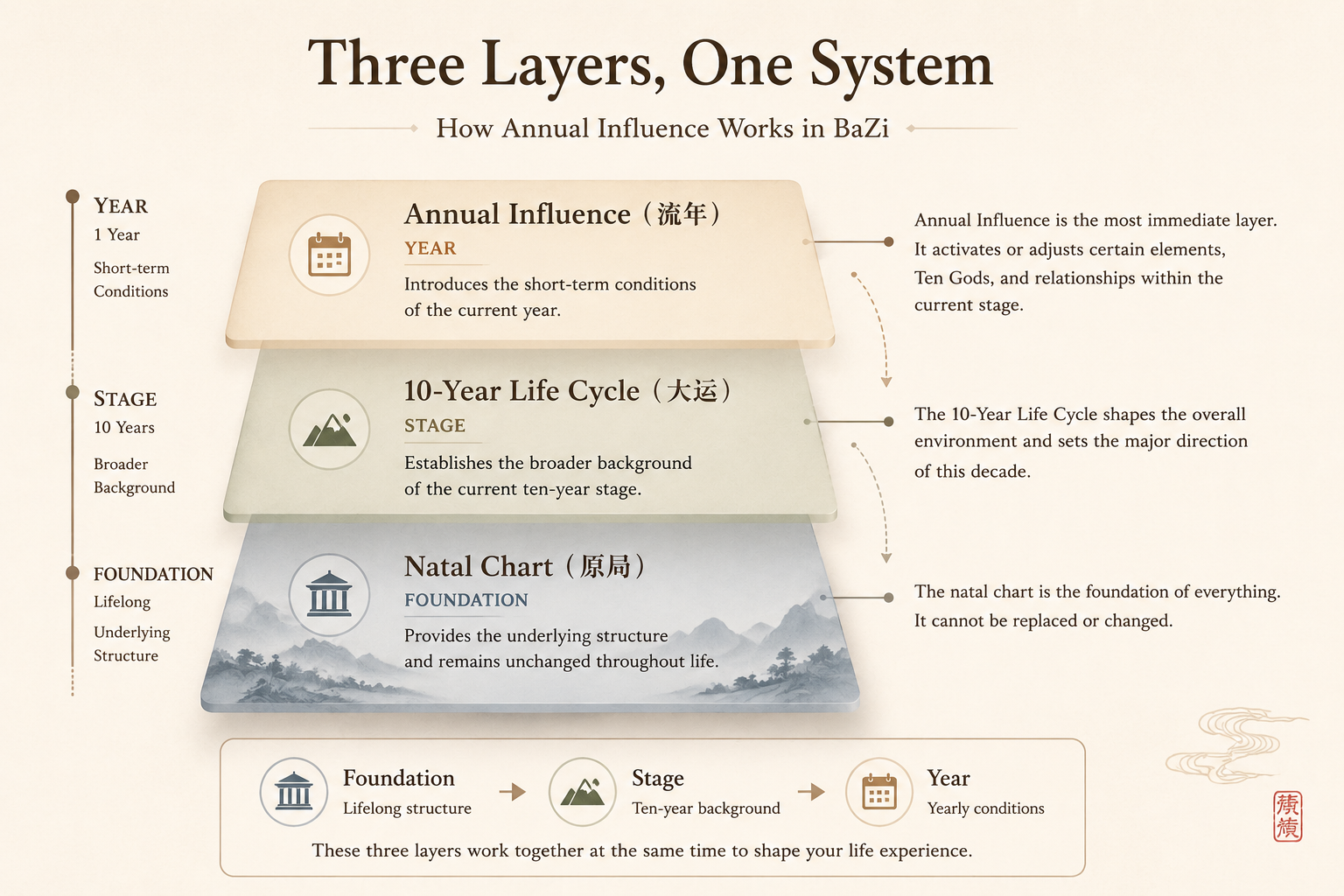
The natal chart provides the underlying structure, the 10-Year Life Cycle establishes the broader stage, and Annual Influence introduces the short-term conditions of a particular year.
Another way to understand this is through an analogy:
* Natal chart = your constitution
* 10-Year Life Cycle = the climate zone of the decade, such as tropical, temperate, or cold
* Annual Influence = whether this particular year brings a rainy season or a drought
Your constitution remains the same. The broader climate zone changes from one 10-Year Life Cycle to another, while the weather fluctuates from year to year within that climate.
Annual Influence is the specific weather of a year. It may reinforce the direction of the current 10-Year Life Cycle, or it may temporarily moderate, redirect, or alter how that cycle is expressed.
All three layers exist and operate at the same time. Annual Influence cannot explain everything, and it cannot be interpreted separately from the natal chart and the current 10-Year Life Cycle.
4. What Changes Can Annual Stems and Branches Introduce?
When the Annual Influence enters the chart, it may:
* increase the strength of a particular Five Element
* introduce new Ten God relationships
* strengthen or weaken the Day Master
* form combinations, clashes, punishments, or harms with natal Stems and Branches
* activate Hidden Stems or root support within the natal chart
* reinforce the direction already being pushed by the current 10-Year Life Cycle
* temporarily offset or alter part of the cycle’s influence
* change which Supportive Elements require the most attention during that year
Annual Influence does not rewrite the natal chart, but it can rearrange which forces take priority.
One element may become more active in one year, while another relationship becomes disturbed or emphasized in the next.
5. How Should the Annual Heavenly Stem and Earthly Branch Be Understood?
The annual Heavenly Stem and Earthly Branch play different roles, but the distinction between them should not be interpreted too rigidly.
Annual Heavenly Stem
The annual Heavenly Stem often represents a more direct and readily observable influence during the year.
The Five Element and Ten God relationship represented by the Stem may appear more clearly in the major themes of the year.
However, the Heavenly Stem cannot determine the entire year on its own. It must either receive support or encounter resistance within the wider chart.
Annual Earthly Branch
The annual Earthly Branch provides a deeper foundation for the year’s influence.
Several characteristics of the Earthly Branch must be considered:
* It contains Hidden Stems: An Earthly Branch does not contain only one element. For example, Wu contains Ding Fire and Ji Earth, while Shen contains Geng Metal, Ren Water, and Wu Earth.
* It forms relationships with natal and cycle Branches: Combinations, clashes, punishments, harms, Three-Harmony Combinations, and Three-Meeting Combinations can all change how the Branch actually functions.
* It provides root support: The annual Branch may give root support to a Heavenly Stem in the natal chart, or it may weaken the foundation on which another Stem depends.
A common oversimplification is:
“The Heavenly Stem represents external matters, while the Earthly Branch represents internal matters.”
This distinction is too absolute. The Heavenly Stem and Earthly Branch operate together as a complete unit. Both work on multiple levels and should not be reduced to “surface” versus “internal” influence.
6. How Does Annual Influence Change the Expression of the Ten Gods?
The same annual Stem-and-Branch combination creates completely different Ten God relationships for different Day Masters.
Suppose the Annual Influence is Bing-Wu(丙午)—Bing Fire in the Heavenly Stem and Wu Fire in the Earthly Branch.
For different Day Masters, this Fire influence represents different relationships:
| Day Master | What Bing-Wu Fire Represents |
|---|---|
| Wood(Jia or Yi) | Eating God / Hurting Officer — expression, creativity, and output |
| Earth(Wu or Ji) | Direct Resource / Indirect Resource — learning, support, and inward development |
| Metal(Geng or Xin) | Direct Officer / Seven Killings — responsibility, pressure, rules, and authority |
| Water(Ren or Gui) | Direct Wealth / Indirect Wealth — money, resources, management, and material outcomes |
| Fire(Bing or Ding) | Friend / Rob Wealth — peers, competition, cooperation, and shared resources |
During the same Bing-Wu year:
* A Wood Day Master may experience a stronger emphasis on expression, creativity, or production.
* A Water Day Master may become more closely involved with money, resources, transactions, or practical results.
* A Metal Day Master may encounter greater responsibility, institutional pressure, rules, or authority.
This is why zodiac-year predictions cannot replace individual BaZi analysis.
The zodiac animal represents only part of the annual Earthly Branch. It does not account for the annual Heavenly Stem, Hidden Stems, the Day Master, the Ten Gods, or the complete natal structure.
7. Why Does the Same Year Affect Different People Differently?
Annual Influence applies to everyone, but it does not function in the same way for everyone.
The same annual Stem-and-Branch combination may reinforce one person’s supportive direction while intensifying imbalance in another chart. Its meaning depends on the Day Master, natal Pattern, current 10-Year Life Cycle, and the specific relationships it forms with the Four Pillars.
It is like the same rainfall falling on different pieces of land.
One field receives the water it needs. Another becomes flooded.
The difference is not in the rain itself, but in the structure and needs of the land receiving it.
General zodiac forecasts place everyone born under the same zodiac sign into one category, ignoring the fundamental differences between individual charts.
8. Annual Influence and Supportive Elements
Annual Influence does not rewrite the underlying structure of the natal chart, but it may cause certain elements to become especially prominent during a particular year.
A Supportive Element in the natal chart may already be sufficiently strong during one annual cycle, meaning that it does not need to be reinforced further. Another element may instead become more useful for regulation and balance.
In other words, the 10-Year Life Cycle and Annual Influence can change the priorities of a particular stage.
An element may generally be supportive in the natal chart but become temporarily excessive during a specific year. Even a relatively balanced chart may develop a temporary directional bias under certain annual conditions.
One element may require more attention this year, while another becomes more important the following year.
9. Annual Influence Is Not a Yearly Prediction
Annual Influence describes the conditions added to a chart during a particular year. It does not guarantee that a specific event will occur.
It provides yearly conditions, not predetermined yearly results.
The same annual Stem-and-Branch combination can produce completely different outcomes when layered over different natal charts and 10-Year Life Cycles.
To understand the general direction of a year, you must examine:
* the Day Master
* the natal Pattern
* the current 10-Year Life Cycle
* the annual Heavenly Stem and Earthly Branch
* the relationships formed between the Annual Influence and the Four Pillars
Without these layers, the interpretation remains incomplete.
10. How Should You Understand Your Own Annual Influence?
When viewing the Annual Influence for a particular year, it is best to read it in the following order:
| Order | What to Examine | Question to Ask |
|---|---|---|
| 1 | Day Master and Natal Pattern | What is the underlying structure of my chart, and what tendencies are already present? |
| 2 | Current 10-Year Life Cycle | Which 10-Year Life Cycle am I currently moving through, and what is the broader background of this stage? |
| 3 | Annual Heavenly Stem | What is the Heavenly Stem of this year, and which Ten God relationship does it form with my Day Master? |
| 4 | Annual Earthly Branch | What is the Earthly Branch of this year, and what relationships does it form with my natal chart and current cycle? |
| 5 | Overall Interpretation | Does this year reinforce, moderate, or redirect the influence of the current 10-Year Life Cycle? |
One key reminder:
Do not judge whether a year is good or bad simply from its zodiac animal or the name of its primary element.
Annual Influence is only one layer. To understand the complete picture of a year, it must be interpreted within the framework of the natal chart and the current 10-Year Life Cycle.
11. Common Misunderstandings
Misunderstanding 1: Annual Influence begins on January 1
In BaZi, the annual Stem-and-Branch transition is usually marked by Li Chun, not January 1 or Lunar New Year.
Misunderstanding 2: Annual Influence is the same as the zodiac year
The zodiac animal represents only part of the annual Earthly Branch. Annual Influence also includes the Heavenly Stem, Hidden Stems, and the Ten God relationships formed with the Day Master. Looking only at the zodiac animal means seeing only a small part of the picture.
Misunderstanding 3: A Wealth year guarantees financial gain
Wealth represents a type of relationship involving money, resources, management, exchange, and material outcomes. It does not guarantee that money will automatically arrive. You must also examine whether the Wealth influence has root support, whether it is clashed or controlled, and whether the current 10-Year Life Cycle supports it.
Misunderstanding 4: A Supportive Element year means everything will go smoothly
A Supportive Element may improve certain parts of the chart while the same Stem-and-Branch combination creates pressure elsewhere. The full annual combination, natal structure, and current cycle must all be considered.
Misunderstanding 5: Annual Influence changes the natal chart
The natal chart does not change. Annual Influence is only a temporary yearly layer added to the original structure.
Misunderstanding 6: Each year contains only one element
Annual Influence includes the Heavenly Stem, Earthly Branch, and the Hidden Stems within that Branch. Several elements may therefore be involved in the same year. An entire year cannot be reduced to a single element.
Main References
* Yuanhai Ziping, Xu Ziping tradition.
* Sanming Tonghui, Wan Minying, Ming dynasty.
* Ziping Zhenquan, Shen Xiaozhan, Qing dynasty.
* Di Tian Sui Chan Wei, traditional text attributed to Liu Ji, commentary by Ren Tieqiao, Qing dynasty.


