The Expression of Jia Wood in BaZi
Explore the meaning of Jia Wood in BaZi, including its Yang Wood nature, traditional tree imagery, seasonal expression, Five Element relationships, Ten Gods roles, and how Jia Wood changes when it becomes the Day Master.
Jia is one of the Ten Heavenly Stems. It belongs to the Wood element and carries Yang polarity, and is therefore known as Jia Wood. Jia Wood may appear in the Heavenly Stem position of the Year, Month, Day, or Hour Pillar. Jia Wood itself represents a form of Yang Wood Qi, but its meaning within a BaZi chart is not fixed. Only when Jia Wood occupies the Heavenly Stem of the Day Pillar is it called the Jia Wood Day Master, becoming the central reference point from which the chart’s Five Element and Ten Gods relationships are established.
1. Basic Attributes
| Attribute | Description |
|---|---|
| Heavenly Stem | Jia 甲 |
| Element | Wood |
| Polarity | Yang |
| Yin–Yang Pair | Yi Wood |
| Traditional Image | A towering tree; structural timber |
| Core Movement | Upward growth; the establishment of structure and order |
| Generates | Fire |
| Controls | Earth |
| Generated by | Water |
| Controlled by | Metal |
| Heavenly Stem Combination | Jia combines with Ji |
| Strongest Season | Spring |
2. Traditional Imagery
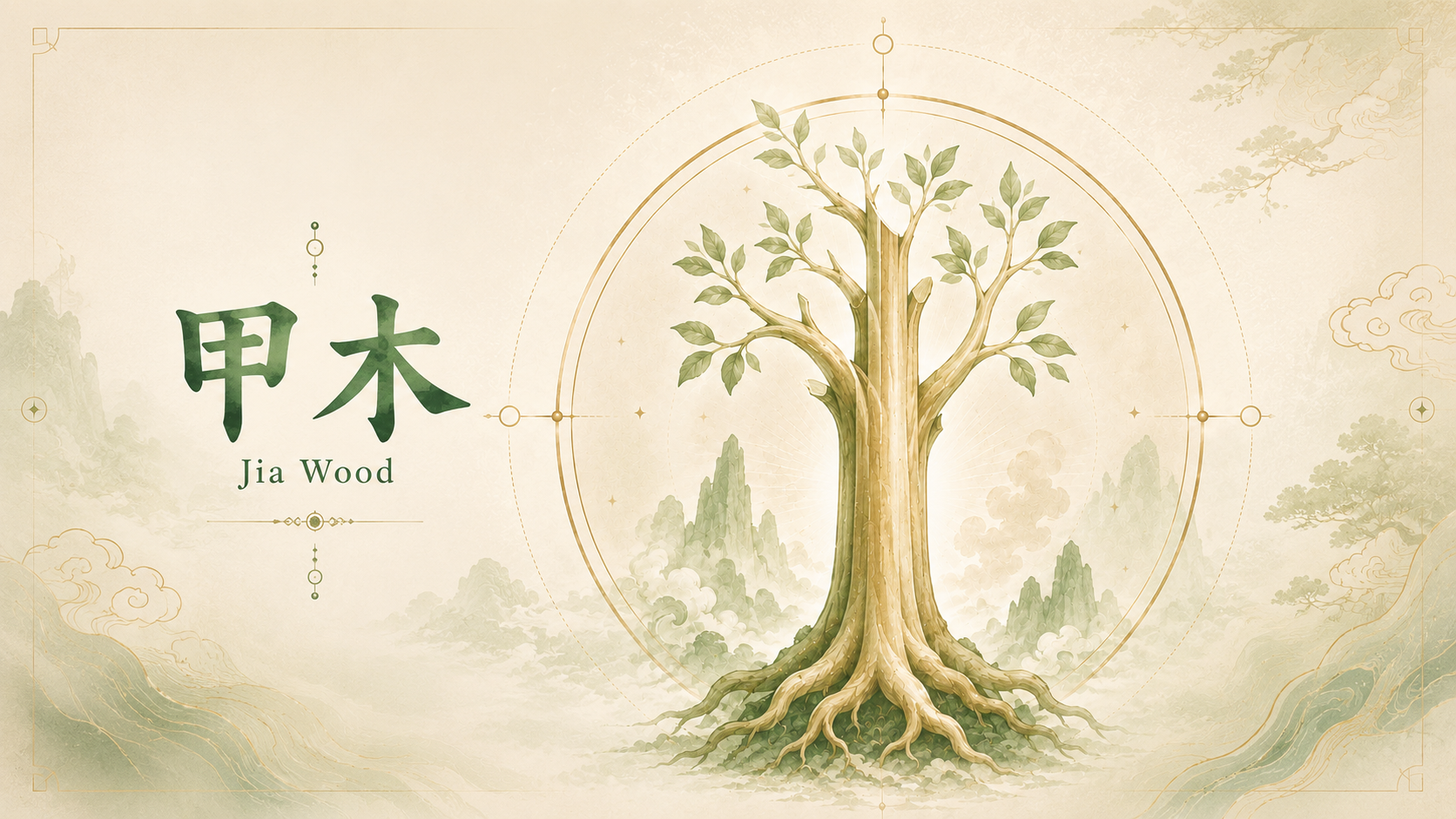
In traditional Chinese metaphysics, Jia Wood is represented by the image of a towering tree or timber suitable for supporting a great structure. The Di Tian Sui describes Jia Wood as reaching toward the heavens and standing firm through the ages.
This image highlights three levels of Jia Wood’s movement.
First, upward growth. The direction of Jia Wood is upward. It continually extends, seeks height, and establishes structure. Unlike Yi Wood, which bends and adapts, Jia Wood grows in an upright manner and carries a tendency to persist against resistance.
Second, the establishment of structure. Jia Wood is associated with structural timber. This suggests the function of supporting, establishing order, assuming responsibility, and becoming a central pillar within a larger system. Jia is the first of the Ten Heavenly Stems, and the Sanming Tonghui associates it with the beginning and development of life.
Third, rooting and bearing weight. For a tree to rise toward the heavens, its roots must be deep. Jia Wood requires space to grow upward, but it also needs a secure foundation below. Deep roots allow luxuriant branches and leaves; only after becoming firmly rooted can the tree extend upward.
Boundary of the image: This natural image is intended to help explain how Jia Wood moves and functions. It does not classify everyone whose chart contains Jia Wood as having the same personality. The tree is a metaphor for the direction of this energy, not a complete description of a person.
3. Core Movement
Natural direction
Jia Wood is a direct expression of vital and generative Qi. In nature, images of vitality, vigorous upward movement, and flourishing growth can all be associated with Jia Wood.
Its natural movement begins with rooting, continues through upward growth, gradually develops an organised structure, and may eventually become the central support of a larger system. This form of energy does not favour stagnation or prolonged suppression. It requires space in which to expand and extend.
Required conditions
Several conditions help Jia Wood function smoothly.
- Roots: A large tree must be rooted in the earth to remain stable. In BaZi, Jia Wood requires support from the Earthly Branches. Yin, the Tiger branch, is Jia Wood’s Lu position and one of its strongest sources of root Qi. Chen Earth may also provide a suitable environment in which Wood can establish roots.
- Fire for climatic regulation: Jia Wood often benefits from Fire, which allows its growing Qi to be expressed and released. In natural imagery, a tree requires warmth and sunlight in order to grow and flourish.
- Metal for shaping: For Jia Wood to become useful timber, it may require the cutting and shaping of Geng Metal. An unshaped tree remains wild timber; through suitable cutting and refinement, it may become structural material.
Harmonious expression
When Jia Wood is functioning harmoniously, the chart may resemble an environment in which the earth is moist, the climate is balanced, and none of the Five Elements becomes excessively extreme.
In structural terms, this may involve:
- sufficient roots;
- a climate that is neither excessively dry nor excessively cold;
- appropriate Fire through which Wood Qi can be expressed;
- suitable Metal that shapes rather than destroys;
- enough space for Jia Wood to extend without being excessively suppressed.
Excessive or obstructed expression
Difficulties in the expression of Jia Wood commonly arise under several conditions.
- Excessive Fire: Fire drains Wood Qi. When Fire becomes excessive, Jia Wood may be consumed too heavily, producing the condition traditionally described as abundant Fire burning Wood.
- Excessive Water: Water generates Wood, but too much Water may cause Wood to float without roots. Jia Wood needs moisture, but it does not benefit from being submerged.
- Excessive Metal: A suitable amount of Metal can shape Jia Wood. Excessive Metal, however, becomes felling rather than refinement.
- Overly heavy Earth: Earth can support the roots of Wood, but excessive Earth may confine or burden them.
- Lack of root Qi: Jia Wood is especially vulnerable when it appears in the Heavenly Stems without sufficient support below. It resembles a tree without roots: visibly upright, but without a secure foundation.
4. Expression Through the Four Seasons
Spring
Spring is the season in which Jia Wood receives the strongest seasonal support. Wood governs spring, so Jia Wood is in season and its energy is naturally abundant.
At this time, Jia Wood often benefits from Fire, which allows its abundant growing Qi to emerge and be expressed. In early spring, Wood may still be tender and the climate cold, so Fire provides warmth and encourages growth. In mid-spring, when Wood is at its height, Fire may help release and circulate its concentrated Qi.
Water may provide supplementary nourishment, but excessive Water is usually unnecessary. Spring Jia Wood should not automatically be subjected to too much Metal, especially when Wood is already strong and Metal is seasonally weak.
Summer
Summer is dominated by Fire, and Jia Wood may be excessively consumed. When Jia Wood appears in a hot and dry summer structure, Output energy may become too strong.
In this environment, Water is often important for climatic regulation. Water can moderate the heat of Fire while nourishing Jia Wood. Without Water, excessive Fire may exhaust Wood Qi, producing the condition commonly described as abundant Fire burning Wood.
Suitable damp Earth may also help retain moisture and moderate excessive heat, but the entire chart must be considered.
Autumn
Autumn is governed by Metal, and Metal controls Wood. Jia Wood appearing in autumn is seasonally weakened and more likely to experience pressure, cutting, or restraint.
At this time, excessive Earth may strengthen Metal and increase the pressure placed upon Wood. Water may provide an important connecting function: it can nourish Wood, moderate dryness, and reduce the severity of Earth and Metal.
Whether autumn Jia Wood can remain stable depends greatly on sufficient root Qi and suitable support.
Winter
Winter is dominated by Water and cold. Jia Wood appearing in winter often requires Fire to warm the structure and activate growth.
Fire can disperse cold and allow Wood Qi to unfold. If Water is abundant while Jia Wood lacks roots, the result may resemble floating timber without a stable place to settle.
In such a case, Jia Wood may require stronger roots or suitable Earth to regulate excessive Water. The complete chart must still be considered before any conclusion is reached.
5. Jia Wood’s Relationships with the Five Elements, Heavenly Stems, and Ten Gods
Jia Wood does not exist as an isolated form of energy. Its meaning in a BaZi chart depends on its relationships with the Five Elements, the other Heavenly Stems, and the Day Master.
Understanding these relationships is essential to understanding how Jia Wood functions in a specific chart.
Jia Wood and the Five Elements
| Relationship | Element | Function |
|---|---|---|
| What generates Jia Wood: Resource | Water | Water nourishes Jia Wood and provides a source for growth. Ren Water resembles rivers and oceans, while Gui Water resembles rain and dew. Both generate Wood, but in different ways. |
| Same element: Companion | Wood | Jia and Yi Wood are of the same element and can increase Wood strength. Jia meeting Jia forms Peer; Jia meeting Yi forms Rob Wealth. |
| What Jia Wood generates: Output | Fire | Fire receives and transforms the growing Qi of Jia Wood. Jia meeting Bing forms Eating God, while Jia meeting Ding forms Hurting Officer. |
| What Jia Wood controls: Wealth | Earth | Earth represents resources that Jia Wood manages or controls. Jia meeting Wu forms Indirect Wealth, while Jia meeting Ji forms Direct Wealth. |
| What controls Jia Wood: Authority | Metal | Metal shapes, regulates, or restrains Jia Wood. Jia meeting Geng forms Seven Killings, while Jia meeting Xin forms Direct Officer. |
Generation is not always beneficial, and control is not always harmful. Whether Jia Wood needs the nourishment of Water or the shaping of Metal depends on the season, its relative strength, and the complete structure of the chart. The same element may produce very different effects in different charts.
Jia Wood and the other Heavenly Stems
Jia Wood forms a network of relationships with Yi Wood, with the Water and Fire elements that generate and receive it, and with the Earth and Metal elements involved in control.
Its most immediate Yin–Yang pairing is with Yi Wood. Both belong to Wood, but Jia is Yang Wood, represented by a large tree or structural timber, while Yi is Yin Wood, represented by flowers, grasses, vines, and flexible vegetation.
In traditional imagery, Yi Wood meeting Jia Wood is sometimes described as vines attaching themselves to a large tree. Yi Wood uses the upright structure of Jia Wood as support through which it can climb and extend.
The Ten Gods role of Jia Wood for different Day Masters
Jia Wood is not inherently one fixed Ten God. Its role depends entirely on which Heavenly Stem is the Day Master.
| Day Master | Jia Wood Becomes |
|---|---|
| Jia Wood | Peer |
| Yi Wood | Rob Wealth |
| Bing Fire | Indirect Resource |
| Ding Fire | Direct Resource |
| Wu Earth | Seven Killings |
| Ji Earth | Direct Officer |
| Geng Metal | Indirect Wealth |
| Xin Metal | Direct Wealth |
| Ren Water | Eating God |
| Gui Water | Hurting Officer |
The same Jia Wood may become Resource, Companion, Output, Wealth, or Authority depending on the Day Master. The Five Element relationship determines the broad category, while the Yin–Yang relationship determines the specific Ten God.
This is why Jia Wood must be interpreted in relation to a complete chart rather than assigned a fixed meaning in isolation.
6. Expression in the Four Pillars
Year Stem
When Jia Wood appears in the Heavenly Stem of the Year Pillar, it occupies a relatively external layer of the chart. It may relate to family background, early environment, social identity, or the part of the chart presented outwardly.
However, the presence of Jia Wood in the Year Stem alone is not sufficient to determine the condition of one’s ancestors, family, or early life.
Month Stem
When Jia Wood appears in the Month Stem, it may relate to the environment of development, social role, work structure, and participation in practical systems.
The Month Branch, or Month Command, has a major influence on the condition of Jia Wood. The Month Stem must therefore be interpreted together with the Month Branch and the seasonal structure.
When Jia Wood occupies the Heavenly Stem of the Day Pillar, it becomes the Day Master and serves as the central reference point from which the chart’s Five Element and Ten Gods relationships are established.
A more detailed explanation appears in Section 7.
Hour Stem
When Jia Wood appears in the Hour Stem, it may relate to plans, productive output, later development, and the direction in which the chart extends.
It should not automatically be interpreted as a fixed prediction regarding children or later life.
The Pillar position changes the level from which Jia Wood is observed, but it does not alter Jia Wood’s elemental nature or Yang polarity. Its actual function must still be interpreted together with the Earthly Branch beneath it and the complete chart.
7. When Jia Wood Becomes the Day Master
What does a Jia Wood Day Master mean?
When the Heavenly Stem of the Day Pillar is Jia Wood, the chart has a Jia Wood Day Master.
The Day Master represents the person as the central reference point of the chart. All other energies are organised around this reference:
- what generates the Day Master becomes Resource;
- what shares its element becomes Companion;
- what the Day Master generates becomes Output;
- what the Day Master controls becomes Wealth;
- what controls the Day Master becomes Authority.
For a Jia Wood Day Master, Jia Wood is the “self” from which all Five Element and Ten Gods relationships are established.
The traditional image of Jia Wood as the Day Master
A Jia Wood Day Master inherits Jia Wood’s traditional imagery: a towering tree, structural timber, and a force that grows upward while establishing form.
As a Day Master, Jia Wood carries an energetic tendency toward upward movement, construction, and extension. However, this describes the natural movement of Jia Wood, not the complete personality or destiny of every person with a Jia Wood Day Master.
Actual temperament and condition depend on the season of birth, Day Master strength, surrounding Five Elements, and the overall chart structure.
The Day Master is not a complete personality type
The condition of a Jia Wood Day Master is not determined by Jia Wood alone. Four variables must be considered.
- Season of birth and Month Command: The season determines Jia Wood’s initial climatic and seasonal condition.
- Day Master strength: Jia Wood may or may not possess roots and support within the chart.
- Surrounding Five Elements: The elements around the Day Master may nourish, strengthen, drain, control, or transform it.
- Overall pattern and Ten Gods configuration: The chart’s structural pattern and distribution of the Ten Gods shape how Jia Wood ultimately functions.
When the Day Master is well supported
A Jia Wood Day Master may be considered well supported when it receives seasonal strength, possesses root Qi in the Earthly Branches, receives support from Resource, or is assisted by Companion energy.
Examples may include:
- being born in spring;
- having strong Wood roots;
- receiving nourishment from Ren or Gui Water;
- receiving support from other Wood stems or branches.
Under these conditions, Jia Wood has sufficient energy to grow upward, establish structure, and carry responsibility.
Being well supported does not mean that the chart is inherently better. It only means that the Day Master has substantial support. How this strength is used depends on the chart’s pattern and Ten Gods arrangement.
When the Day Master needs support
A Jia Wood Day Master may require support when it is out of season, lacks root Qi, is heavily drained by Fire or Earth, or is excessively controlled by Metal.
For example, Jia Wood born in autumn without sufficient Water or Wood may struggle to maintain its own strength. Water may provide nourishment, while additional Wood may provide root or Companion support.
However, needing support is not the same as simply adding whatever is missing. Whether Water, Wood, or another element is helpful must be determined through the structure of the entire chart.
When the Day Master is excessive or obstructed
More Jia Wood is not always better, and greater strength is not automatically more favourable.
When Jia Wood is excessively strong and lacks a channel for expression, it may become rigid, overextended, or unable to adapt. When Jia Wood is too weak and lacks support, it may struggle to maintain direction or structural stability.
Strength does not automatically mean fortune, and weakness does not automatically mean misfortune. The central issue is whether the chart has structure and circulation.
Five Element roles around the Day Master
When the Day Master is Jia Wood, the Five Elements correspond to the following Ten Gods categories.
| Role | Ten Gods | Elemental Direction |
|---|---|---|
| What generates the Day Master: Resource | Direct Resource, Indirect Resource | Water: Ren and Gui |
| Same element: Companion | Peer, Rob Wealth | Wood: Jia and Yi |
| What the Day Master generates: Output | Eating God, Hurting Officer | Fire: Bing and Ding |
| What the Day Master controls: Wealth | Direct Wealth, Indirect Wealth | Earth: Wu and Ji |
| What controls the Day Master: Authority | Direct Officer, Seven Killings | Metal: Geng and Xin |
More specifically:
- Ren Water: Indirect Resource
- Gui Water: Direct Resource
- Jia Wood: Peer
- Yi Wood: Rob Wealth
- Geng Metal: Seven Killings
Which elements may support a Jia Wood Day Master?
Each of the Five Elements may affect a Jia Wood Day Master differently. Its function depends on the chart’s structure and state of circulation.
- Water — Resource: Water nourishes Jia Wood and provides a foundation for growth. However, winter Wood may already be cold, in which case Fire may also be required. Water should not be added without considering temperature and roots.
- Wood — Companion: Wood increases the Day Master’s same-element strength and may provide support. When Wood is already excessive, however, additional Wood may increase imbalance and require Fire for expression or Metal for shaping.
- Fire — Output: Fire receives Jia Wood’s growing Qi and allows talent or energy to be expressed. Excessive Fire, however, can drain Jia Wood too heavily and may require Resource support.
- Earth — Wealth: Earth represents resources managed or controlled by Jia Wood. Earth may provide a place for roots, but excessive Earth may burden or confine Wood.
- Metal — Authority: Metal shapes and regulates Jia Wood. Jia Wood may require suitable Metal to become useful timber, but weak Wood should not be excessively controlled by strong Metal.
Which direction is most supportive for a particular Jia Wood Day Master depends on the season, relative strength, chart pattern, and the needs of the overall structure.
8. Common Misunderstandings
Does the presence of Jia Wood mean that someone has a Jia Wood Day Master?
No. Jia Wood may appear in the Year, Month, Day, or Hour Stem. It becomes the Jia Wood Day Master only when it occupies the Heavenly Stem of the Day Pillar.
In every other position, it remains one component of the complete chart.
Does every Jia Wood Day Master have the same personality?
No. Jia Wood as the Day Master establishes the chart’s energetic centre, but actual temperament and behaviour depend on the season, Day Master strength, surrounding Five Elements, and overall pattern.
Two people with a Jia Wood Day Master may present very differently because their chart structures are different.
Does a Jia Wood Day Master always benefit from Water or Wood?
Not necessarily. When Jia Wood already receives sufficient support, additional Water or Wood may increase imbalance.
A hot Jia Wood chart may require climatic regulation, while a chart dominated by Metal must first consider the relative strength and roots of Wood. A fixed rule such as “Jia Wood always favours Water and Wood” cannot be applied universally.
Does having a Wood Day Master mean that the chart lacks Wood?
No. The Day Master being Jia Wood means that Wood is used as the central reference point of the chart. It does not indicate whether Wood is abundant or deficient.
A Jia Wood Day Master may exist in a chart where Wood is extremely strong or extremely weak.
Is a stronger Day Master always better?
No. Strength and weakness describe structural states; they do not directly equal good or bad fortune.
Jia Wood that is excessively strong but lacks expression may become rigid or obstructed. Jia Wood that is weak and unsupported may lack stability and direction. Both conditions must be evaluated through the complete structure of the chart.
9. Reading Jia Wood Within the Complete Chart
Understanding Jia Wood’s Yin–Yang and Five Element attributes, traditional imagery, and core movement provides a foundation for recognising an important symbol in BaZi. However, Jia Wood cannot be interpreted correctly in isolation from the complete chart.
Jia Wood may appear in the Heavenly Stem of any of the Four Pillars, and each position provides a different level of observation. It becomes the Day Master only when it appears in the Day Stem. In every other position, it remains one of many components whose function depends on the Earthly Branch beneath it, the season, the surrounding stems and branches, and the overall chart pattern.
Wherever Jia Wood appears, its fundamental elemental nature and direction remain consistent: it is Yang Wood, associated with upward growth and the establishment of structure. Yet its specific role in an individual chart still requires the complete BaZi structure to be considered.
Understanding Jia Wood is therefore an important part of reading a chart, but it is not the complete conclusion.
Main References
* Yuanhai Ziping, Xu Ziping tradition.
* Sanming Tonghui, Wan Minying, Ming dynasty.
* Ziping Zhenquan.
* Li Wenchuan, Feng Chia University, The Application of Yin-Yang and the Five Elements: BaZi Destiny Analysis.


